
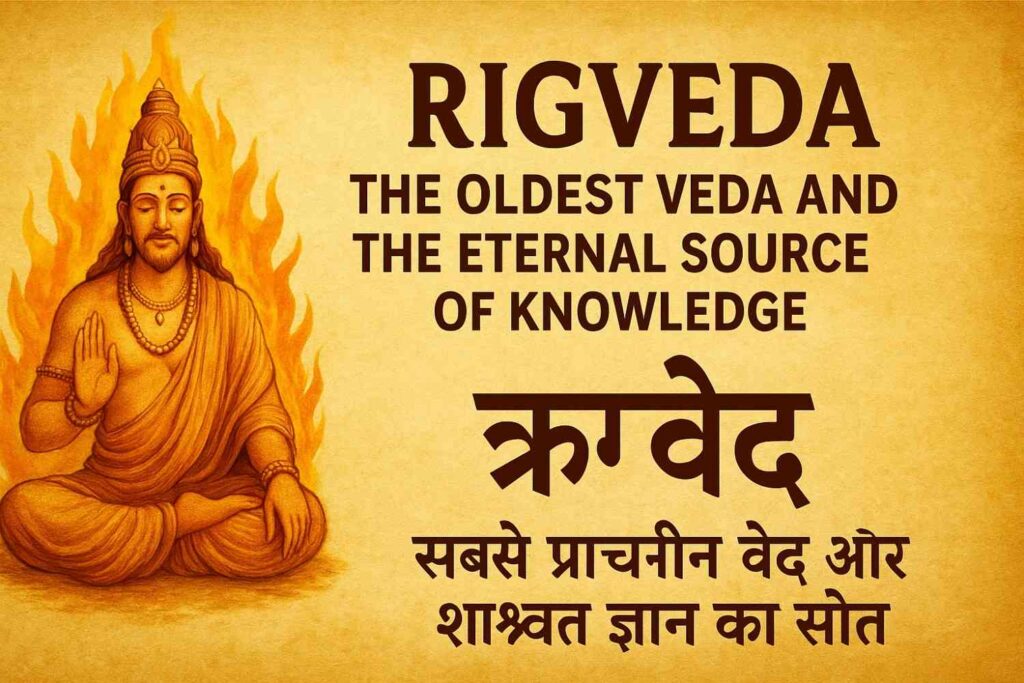
The Rigveda is not just a book; it is the foundation of a civilization. As the oldest of the four Vedas, it is the world’s oldest extant text in any Indo-European language. Composed in an ancient form of Sanskrit, it is a collection of profound hymns that form the bedrock of what would later be known as Hinduism.
For scholars, it is a linguistic marvel and a historical treasure trove. For spiritual seekers, it is a reservoir of timeless wisdom and the first recorded utterances of humanity’s quest for the divine.
This comprehensive guide will journey into the heart of the Rigveda, exploring its origins, structure, the gods it venerates, and the profound philosophical ideas that continue to resonate thousands of years after its composition.
What is the Rigveda? Understanding its Significance
The name ‘Rigveda’ comes from the Sanskrit words ‘ric’ (meaning “praise” or “verse”) and ‘veda’ (meaning “knowledge”). Thus, it literally translates to “The Knowledge of the Verses of Praise.”
The Rigveda is the first and most ancient of the four Vedas, the other three being the Yajurveda, Samaveda, and Atharvaveda. Composed between 1500–1200 BCE, it is a collection of 1,028 hymns (suktas) divided into 10 books (Mandalas).
Each hymn is dedicated to different deities such as Agni (fire), Indra (rain and thunder), Varuna (cosmic order), and Surya (the Sun). The verses celebrate the forces of nature, emphasizing gratitude, discipline, and divine harmony.
Its significance is immense:
- Historical: It provides a window into the life, culture, and beliefs of the early Vedic people in the Indian subcontinent.
- Linguistic: It is the primary source for understanding the earliest form of Sanskrit, Vedic Sanskrit, and is crucial for the study of comparative linguistics.
- Religious: It lays the philosophical and ritualistic groundwork for all subsequent Hindu thought, scripture, and practice.
The Origins of the Rigveda
The Rigveda was composed by rishis (sages) over centuries through oral tradition. It was passed down from generation to generation with perfect precision — a remarkable feat of memory and devotion.
- Language: Vedic Sanskrit
- Structure: 10 Mandalas, 1,028 hymns, and about 10,600 verses
- Composers: Various rishis like Vishvamitra, Vashistha, Atri, Bharadvaja, and Gritsamada
These hymns are not just prayers; they are poetic expressions of cosmic truth, natural phenomena, and human consciousness.
The Structure and Organization of the Text
The Rigveda is systematically organized into ten Mandalas (books). The arrangement is not random but reflects both thematic and historical layers of composition.
- Mandalas 2-7: These are the oldest and shortest books, each attributed to a specific family of Rishis (the “family books”). They form the core of the Rigveda.
- Mandalas 1 & 10: These are generally considered the latest additions. Mandala 1 is a mix of old and new hymns, while Mandala 10 contains some of the most famous and philosophically advanced hymns, including the Purusha Sukta (Hymn of the Cosmic Being) and the Nasadiya Sukta (The Hymn of Creation).
The hymns are further divided into individual verses called ‘rics’. The entire text contains over 10,600 verses.
The Pantheon of Gods in the Rigveda
The Rigvedic hymns are invocations to a pantheon of deities, who are largely personifications of natural forces. The primary mode of worship was through the fire sacrifice (yajna), where hymns were chanted to invite the gods to partake of the offerings.
The most prominent Rigvedic gods include:
- Indra: The king of the gods, a warrior deity associated with thunder, rain, and war. The most hymns (about 250) are dedicated to him, celebrating his heroic deed of slaying the serpent-demon Vritra to release the waters.
- Agni: The god of fire. As the divine priest, he acts as the intermediary between humans and gods, carrying the offerings of the sacrifice to the celestial realms. He is the second most important deity.
- Varuna: The upholder of cosmic order (Rta). He is a stern, moral sovereign who oversees the laws of the universe and is associated with the sky and oceans.
- Soma: Both a god and a sacred ritual drink. The Soma plant, whose identity is now lost, was pressed to create a hallucinogenic juice that was consumed by priests during rituals, believed to confer immortality and a direct connection to the gods.
Other significant deities include Surya (the Sun God), Vayu (the Wind God), and the Ashvins (twin physicians of the gods).
Major Themes of the Rigveda
- Nature Worship: The Rigveda portrays every element of nature as divine — rivers, wind, fire, and sun are seen as living gods.
- Universal Order (Rita): The concept of cosmic law and moral order that governs everything.
- Unity in Diversity: Though many gods are worshipped, the Rigveda subtly teaches “Ekam sat vipra bahudha vadanti” — “Truth is one, sages call it by many names.”
- Spiritual Growth: The hymns inspire humans to seek knowledge (jnana), truth (satya), and righteousness (dharma).
Key Deities in Rigveda
| Deity | Representation | Significance |
|---|---|---|
| Agni | Fire | Symbol of transformation and sacrifice |
| Indra | Thunder & Rain | Leader of gods, destroyer of ignorance |
| Varuna | Cosmic Order | Maintainer of truth and justice |
| Surya | Sun | Source of energy and enlightenment |
| Soma | Sacred drink | Symbol of divine inspiration |
Profound Philosophical Hymns and Concepts
While the Rigveda is often seen as a text of ritualistic polytheism, it contains the seeds of the profound monistic and philosophical thought that would fully blossom in the Upanishads.
The Rigveda is not only a book of rituals but also a philosophical treasure. It asks profound questions about the origin of the universe, consciousness, and God.
One famous hymn, Nasadiya Sukta (10.129), explores the mystery of creation:
“Who truly knows, who can declare,
Whence it was born, whence came this creation?
The gods are later than this world’s formation,
Who then knows whence it has arisen?”
Such verses reflect the scientific curiosity and open-minded spirituality of ancient India.
Key philosophical hymns include:
- The Nasadiya Sukta (10.129): The “Hymn of Creation” is a stunningly modern-sounding inquiry into the origin of the universe. It ends with agnostic humility, stating that even the gods came after creation and that perhaps “the one who looks down from the highest heaven, only he knows—or perhaps he does not know.”
- The Purusha Sukta (10.90): This hymn describes the universe and human society as originating from the sacrifice of a cosmic giant, Purusha. It presents a cosmological view of the origin of the four social classes (varnas).
- The Concept of Rta: This is a fundamental Rigvedic principle representing the cosmic, moral, and physical order of the universe. It is the law that governs everything, from the path of the sun to the outcome of a righteous action.
Importance of Rigveda in Modern Times
The teachings of the Rigveda remain relevant even today:
- Promotes environmental harmony and respect for nature
- Inspires unity beyond religion and region
- Encourages self-knowledge and spiritual awakening
- Serves as the foundation of Indian culture, literature, and philosophy
Many concepts of yoga, Ayurveda, and Indian ethics trace their roots back to the Rigvedic age.
Rigveda and Indian Civilization
The Rigveda represents the dawn of Vedic civilization, where spirituality and daily life were deeply connected. It influenced:
- Indian languages through Vedic Sanskrit
- Vedic rituals and yajnas (sacrifices)
- Hindu festivals and worship traditions
- Art, music, and poetry rooted in Vedic chanting (Samagana)
Frequently Asked Questions (FAQ)
Q1: What is the main purpose of the Rigveda?
The primary purpose was liturgical. Its hymns were composed to be recited during fire sacrifices (yajnas) to praise and invoke the deities, seeking their blessings for prosperity, victory, and cosmic order.
Q2: Who wrote the Rigveda?
The Rigveda was not “written” but composed orally by numerous Rishis (seers) over generations. Key visionary families include the Vishvamitras, Vamadevas, and the Angirases.
Q3: How is the Rigveda different from the other Vedas?
The Rigveda is primarily a collection of hymns of praise. The Sama Veda sets many of these hymns to music for chanting. The Yajur Veda provides the procedural prose formulas for rituals, and the Atharva Veda contains spells, charms, and more folkloric incantations.
Q4: Can I read the Rigveda in English?
Yes, there are several English translations available. Renowned translators include Ralph T.H. Griffith, Wendy Doniger, and Stephanie W. Jamison & Joel P. Brereton. It’s advisable to read with a commentary for better understanding.
Conclusion:
The Rigveda is not just an ancient book; it is a living scripture — a mirror of India’s timeless spiritual quest. Its verses echo the message of peace, truth, and universal oneness. Studying the Rigveda connects us to our roots and reminds us that true progress lies in harmony with nature, knowledge, and the divine.
From its vibrant hymns to warrior gods to its deep, questioning philosophy, it offers a complete worldview. To engage with the Rigveda is to connect with the very origins of thought, language, and spirituality—a journey as relevant today as it was over three millennia ago.
The Eternal Tapestry: A Journey into Hinduism’s History, Culture, and Regional Traditions
